
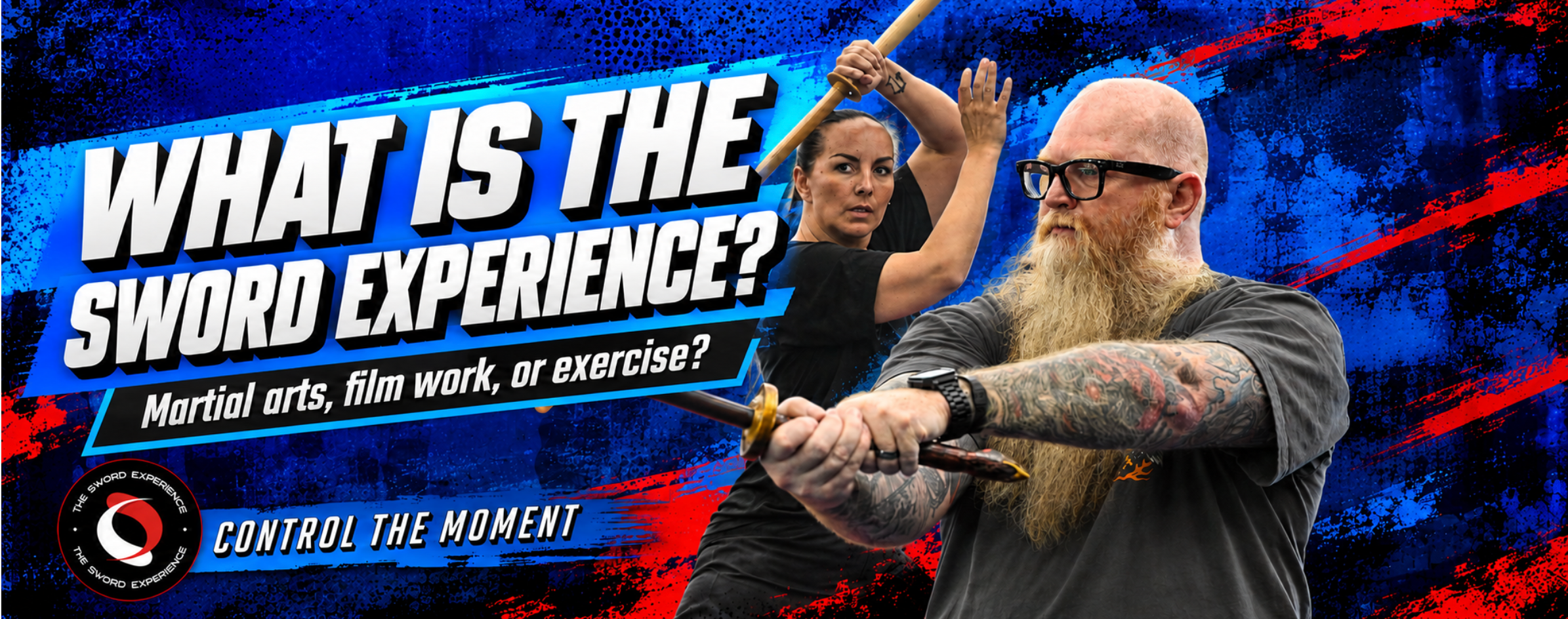
What is the Sword Experience: martial arts, film work, or exercise?
A blade rises. A foot shifts. Two opponents study each other, waiting for the moment to move.
You know that feeling. The playful challenge between Westley and Inigo Montoya in The Princess Bride. The confidence of Zorro. The intensity of Duncan MacLeod facing his next opponent in Highlander. A great sword scene makes you lean forward. Somewhere between the first exchange and the final move, you think: I want to try that.
Welcome to The Sword Experience. Founded by Adrian Paul, the actor behind Duncan MacLeod, SXP brings you into the movement behind the moment. Sword in hand, you explore distancing, targeting, footwork, and control, alongside the performance details that make choreography believable on screen. The technique and the storytelling develop together.
Then your legs get involved. Your attention sharpens. You begin noticing where your hands finish, how your weight shifts, and what changes when you move closer to your partner. A sequence that looked effortless on screen suddenly gives you plenty to think about in person.
So, is The Sword Experience martial arts, film work, or exercise? There is something of all three in the experience. You might arrive knowing exactly what draws you in, or simply wanting to find out what it feels like to hold a sword. Either way, there is more to discover than the blade in your hand.
The martial arts connection: learning to move with control
Before the dramatic exchange comes a quieter skill: knowing where you are. Sword training begins with understanding where your practice sword is going and how your movement relates to the person in front of you. Stance, grip, footwork, distancing, and targeting form the foundation. They give the action its shape.
Distancing: finding the right range
Distancing is the space between you and your training partner in relation to the movement you are practicing. That space changes as either person steps forward, moves back, or changes direction. Reach, the length of the practice sword, and the exercise itself all affect the range you need.
Too far away, and you may lean or stretch to complete a movement, pulling yourself out of balance. Too close, and you reduce the room available to guide the practice sword and respond with control. Footwork lets you adjust that space while maintaining a stable position.
In a coached drill, pay attention to your starting position and where you finish. Can you complete the assigned movement without overreaching? Can you return to your starting position with balance? If your partner moves, does your distance still work? The instructor helps you recognize and correct those changes at a controlled pace.
Targeting: giving each movement a clear destination
Targeting means directing the practice sword toward the specific point or line assigned in the exercise. You learn where a movement begins, the path it follows, and where it should finish. The SXP numbering system gives participants a shared reference for learning and recalling those movements.
Accuracy includes being able to stop where instructed. A movement that starts correctly but travels beyond its intended finish still needs adjustment. Slow practice gives you time to notice the path, your hand position, and whether you can repeat the movement consistently.
Partner exercises also depend on following the agreed target and sequence. Changing the target unexpectedly changes what your partner has to respond to. Listen to the instructions, maintain the assigned distance, and keep each repetition controlled.
Speed: want to move like an action hero? Start in slow motion.
Speed feels exciting. It can also let you rush straight past the details that need your attention. Practicing extremely slowly gives you time to notice your hand position, where you place your feet, and how your weight shifts from one movement to the next. Can you stay balanced through the transition? Do your hands finish where they should? Learn to understand and control the movement before adding speed. Patience here gives your later movement something solid to build on.
Give the details time, and give yourself permission to learn.
The exercise connection: movement with a purpose
The sword gets the close-up. Your legs do much of the work.
You step, shift your weight, change direction, and recover your position. Your legs support the movement while your trunk and arms coordinate the practice sword. Repeated sequences can challenge your stamina as well as your concentration.
You have a reason for every step: finding your range, recovering your balance, or connecting one movement to the next. Instead of counting down until the exercise is over, you may find yourself asking to try the sequence one more time.
Progress becomes something you can feel. The transition that caught you out earlier begins to flow. You remember the next movement without stopping. There is satisfaction in discovering that your body can learn something your mind initially found confusing.
The physical demands depend on the session and your pace. Read the event description, choose the appropriate level, and speak with the team about your needs. Good training begins with understanding what you are stepping into.
Why it can feel like meditation in motion
For all that action, one of the most interesting moments can be surprisingly quiet: you realize you have been thinking about nothing except the movement in front of you.
Your feet. Your breath. The next movement. A short sequence gives your attention somewhere specific to go. When your mind wanders, you have a task to return to.
That is why sword practice can feel like meditation in motion. You do not need to empty your mind or perform a flawless sequence. You practice noticing where you are, making an adjustment, and continuing. Presence becomes something you do, one repetition at a time.
A reminder to breathe can bring you back to how you are moving. A missed step gives you something to revisit. There is a useful lesson in that: a mistake can inform your next attempt without defining it.
The last movement is finished. Give the next one your attention.
What connects all three? Control the Moment.
Our 2026 standard is A Cut Above the Rest. The skill we are building all year is Control the Moment.
In the fundamentals, that means knowing where your body and practice sword are going. In
choreography, it means staying aware of your partner and the sequence. In the physical work, it means keeping your movement deliberate as the effort builds.
At your next session, choose one thing to notice. Perhaps you rush a transition, lift your shoulders, or forget to reset your feet. Give that detail your attention. Ask for feedback. Try again. You cannot improve every part of a sequence at once, but you can give the next repetition a clear purpose.
Returning to the same movement with better awareness is progress, whether this is your first event or your tenth. That idea travels well beyond sword training: listen closely, stay willing to adjust, and give your attention to the part you can influence.
The film work connection: making action believable
Now return to the sword scene that first caught your imagination. Watch the steps between the blade
movements. The pause before an exchange. The way one person’s action gives the other a reason to respond. Technique supports the performance; timing and intention help turn it into a story.
SXP offers a way into the craft behind that action through sword choreography and, depending on the event, insights into performing for the camera. The exact format varies, from condensed training sessions to more immersive experiences.
Working through choreography means knowing your movement, understanding your partner’s
movement, and paying attention to how they connect. A sequence needs timing, clear communication, and repeatable control.
Imagine learning a short exchange. At first, remembering what comes next takes most of your attention.
With practice, you begin noticing more: the distance between you, when to move, and whether you have given your partner time to respond. The sequence starts to feel like a conversation, with each movement connected to the one before it.
On screen, the characters may be opponents. In practice, the performers are collaborators. Both contribute to a believable result. Your partner’s success becomes part of your own.
Adrian’s work as Duncan MacLeod gives Highlander fans a direct connection to the action that sparked their interest. Learning with the performer behind the character brings the conversation back to real people doing deliberate work. A few gripping seconds on screen can give you a whole new appreciation for a carefully practiced step.
The part that helps you keep going: community
Movie heroes may get you through the door. The people training beside you can give you a reason to come back. A useful correction, encouragement from a partner, or a shared laugh after forgetting the next move can change how a challenging session feels.
There is room here for questions: Why does this movement feel awkward? Am I doing it correctly? What should I work on next? Asking is part of learning. So is being willing to look like a beginner while you become more capable.
That is the community we want to build: people who stay curious, support each other, and keep showing up ready to learn. You bring your own starting point. The person beside you brings theirs. The exchange gives both of you something to work with.
Be willing to be a beginner. Stay curious enough to keep learning.
Find your next Sword Experience
So, martial arts, film work, or exercise? The Sword Experience brings elements of all three together: technique to give your movement purpose, physical practice to challenge you, and choreography to put those skills into a shared story.
You might come because you love movie sword fights, want to develop your skills, or feel ready for a different kind of physical challenge. This fall, bring that curiosity to the training floor.
Longs Peak Scottish Irish Highland Festival | Estes Park, Colorado
Join Adrian Paul for condensed sword sessions covering handling, swing control, attack and defense positions, and more. Choose a session that fits your experience. Advanced tickets require prior sword training, and separate festival admission is required.
Explore Estes Park sessions and book your place
Highlander Tour Season 4 | Vancouver, Canada
October 9-11, 2026. Make it a Highlander weekend with a meet and greet, Saturday sword training with Adrian at Barnet Marine Park, and a Sunday filming-location tour. Review the available packages, including the Saturday-only training option, to choose your experience.Explore Vancouver tickets and packages
Come for the part that sparks your interest. See what else you discover when you pick up the sword.
A Cut Above the Rest. Control the Moment.
No approved comments yet.
Leave a Reply