
Why Sword Training Feels Better Than the Gym (and Actually Gets Results)
Gyms build muscle. Swords build muscle and momentum. You could do three sets of lunges. Or you could grab a sword and rehearse a fight scene that secretly gives you full-body conditioning, balance training, and focus like nothing else. Sword training is cardio in disguise. It’s also more fun to talk about at parties.
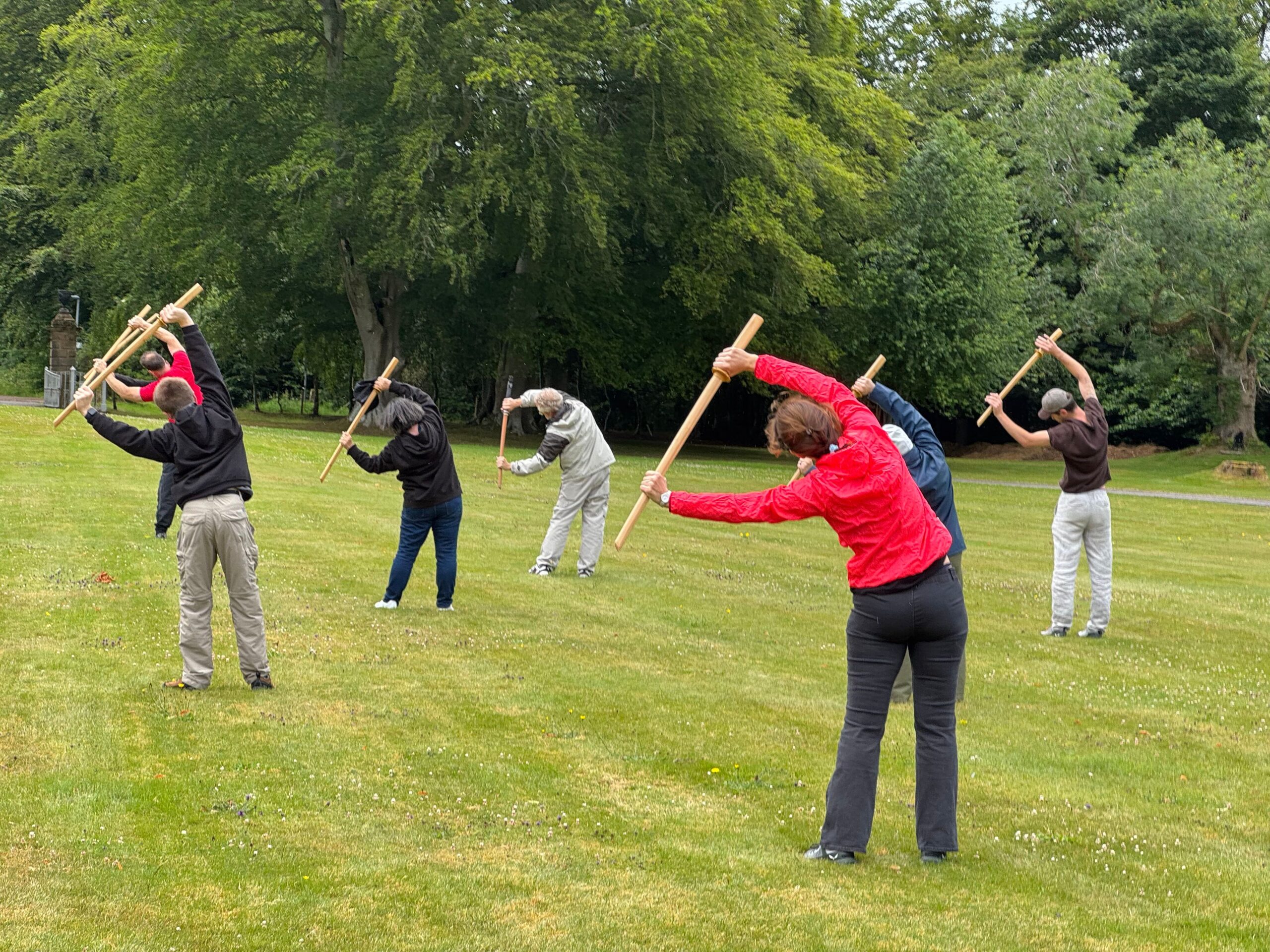
That’s right! Sword training really is full body, skill based, and strangely addictive. You get cardio, strength, mobility, and a story your brain actually cares about.
New here? Start at the Sword Experience homepage.
Two easy paths
Option 1. Learn by video
Follow the step by step lessons in the Online Academy. It is easier than decoding text, and the SXP numbering system is built into every class.
Option 2. Learn with written steps
Use the cues below as a starting point, then pair them with real coaching for best results and safety. Follow along in the SXP Online Academy or train with us in person via Tours and Events. Video guidance and live feedback will dial in your stance, grip, blade path, footwork, breath, and recovery so your reps stay clean and consistent.
Safety note. Use trainers, not sharps. If anything hurts, stop and talk to a professional.
Before you move
Space
Clear a 10 by 10 foot area. No low ceilings. No pets auditioning for stunts.
Trainer
Use a bokken or practice blade from the Shop.
Warm up, 3 minutes
- Wrist circles, ten each way
- Shoulder rolls, ten each way
- Hip circles, ten each way
- Ankle rocks, ten each side
- Two calm breaths in guard
NOTE: A sword has three keep components. Handle, for blade movement. Lower third of the blade just above the guard/tsuba (used for defense). Upper third of the towards the tip (used for attacks)
The SXP numbering system in one minute
SXP assigns numbers to attack lines and matching defenses so partners can call clean cues.
Typical map used in class. When facing an opponent.
- 1: Right shoulder attack
- 2: Left shoulder attack
- 3: Right hip attack
- 4: Left Hip Attack
- 5: Diagonal upper Cut from right to left
- 6: Diagonal upper Cut from left to right
- 7: Downward diagonal cut, Target – right side Trapezium
- 8: Central thrust to mid chest.
Partner script
- Attacker says the number before the strike
- Defender repeats the number while parrying
- Both say recover on the reset
Your coach may tweak angles for safety or camera. Use the numbers given in the moment.
How to hold the sword
Grip
- Hold the sword in your left hand- Slide the right hand to the guard (Tsuba) until your thumb creates a triangle with the guard. Your grip should now be – Middle, Ring and Pinky fingers. The thumb and index finger should be loose, allowing the tip of the bokken free movement. Now place the left hand toward the end of the handle with about one inch of space between hands
- Grip pressure about 100% pinky finger, 80% ring finger and 60% middle finger
- Thumbs long, not clamped
- Wrists neutral with the blade, no kinks
Neutral guard
- Feet hip width apart
- Step the left foot backwards, or the right foot forwards so the right foot is pointed toward the target, and left rear foot is turned out about 45 degrees
- Knees soft, ribs stacked over pelvis, shoulders down
- Blade about 30 degrees off vertical, tip pointed just below partner’s chin line
- Eyes on a single point
How to do clean SXP1A and SXP2A cuts
We will build the two most common cuts. Learn them slow, then crisp.
SXP1 A(attack), Target Opponents Left Shoulder.
- Load the weight onto your back foot as you begin the arc of your movement, so that you can advance your right foot forward by the time you have ended the swing towards your target.
- As you rotate the blade in an arc around your head, the movement begins with the wrist, then elbows then. shoulders. If there is no wrist bend at the beginning of your movement, then you will move the blade with the arms and not let the blade move freely.
- Allow the Blade path to travel from left to right in a smooth motion to your target’s left shoulder, with little movement in your shoulders as you perform the move.
- As the blade moves around you, the edge alignment stays horizontal to the ground and the tip of the weapon points all the way behind your head.
- Finish with point at opponents left shoulder. Arms slightly bent. IMPORTANT- At the end of the movement DO NOT bend the left wrist inwards, losing grip with the handle. Your blade should be pointed to the outside of your opponent’s left shoulder with tips of your fingers facing upwards in a supinated position. Your left wrist must end in a strong, almost straight, position. You cannot deliver a cut with a loose left wrist. Should you wish to continue the cut, the next thing to move would be your hips, not your hands or arms.
Common fixes for 1
- If the arm is doing all the work, let the left wrist bend at the beginning of the movement.
- If the cut drifts, slow down and trace the same path twice before adding speed.
SXP2A, Opponents right Shoulder Attack
- From the end of your SXP1 movement begin to bring the weapon on a return path to your opponent’s right shoulder.
- This time by the time you end the move, step your left foot forward towards your target.
- Again, allow the blade to travel from right to left in a smooth motion to your target’s right shoulder, with little movement in your own as you perform the move.
- Finish with the tip of your weapon pointing outside your opponent’s right shoulder, and looking at the top of your hand, so that your hands are in pronated position.
- Then recover to Mid guard.
NOTE: If your hands are not in a supinate or pronated position at the end of the movements you will have struck your opponent with the side, not the edge of your blade.
Common fixes for 2
- If the shoulder hikes, exhale and lower it before the swing
- If balance wobbles, shorten the step and widen the stance
Basic parries for 1 and 2
SXP 1D (Defense) Left shoulder defense
- Begin in neutral guard position. Right foot forward
- Push backwards off the right foot to retreat in a defensive position keeping your hips facing forward.
- At the same time move your hands (not the blade) to your left side, with the blade pointing 45 degrees away from you and towards the opponent.
- Meet opponent’s blade about one foot in front of your face and high enough to use the defensive portion of the blade. Elbow tucked inside.
SXP 2D – Right shoulder Defense
- Now from the end SXP1D position step your right foot back and bring the hands across to your right side blocking your opponent’s strike.
- IMPORTANT DO NOT TURN YOUR HIPS OR SHOULDERS. Face them towards your opponent. Failure to do this will bring sword too far to the right exposing the left shoulder.
- Elbows stay soft. Blade points 45 degrees away from you and towards the opponent. Elbows tucked in.
Say the number before you parry. Words lock timing.
A ten minute starter session
- Warm up for 2 minutes
- Stance holds for 1 minute, 30 seconds each side
- Number 1 cuts for 2 minutes, slow to crisp
- Number 2 cuts for 2 minutes, slow to crisp
- Number 1 & 2 cuts from side to side for 2 minutes
- Simple call and answer for 2 minutes
- Solo: say “1,” cut 1, recover. Say “2,” cut 2, recover
- Partner: attacker calls the number, defender parries and repeats it
- Cool down for 1 minute, wrists and shoulders
Film the last thirty seconds. You will see what your body already felt.
Why this beats your gym rut
Total body in every rep
Cuts and parries use legs, hips, core, back, shoulders, and grip at once.
Rotational strength with control
You build power through the feet and hips. Your lower back stops complaining.
Cardio that does not slog
Short bursts with resets create natural intervals.
Mobility from doing, not forcing
Stances open hips and shoulders while you move.
A skill you can show
Timing, distance, and clean exits carry over to daily life and sport.
Want a plan that scales week to week. Use the Online Academy. Want immersion. Pick a date on Tours and Events.
Progress checks for September
- You can hold each stance 45 seconds without fidgeting
- Number 1 and 2 look the same on repeat
- Parries meet early and glide off center
- You recover to guard before your feet start wandering
Next steps
- Explore everything from the homepage
- Train the numbered system in the Online Academy
- Grab a bokken or trainer in the Shop
- See it live on Tours and Events
If you post your practice, tag #SwordExperience, #SXPAcademy, and #SwordXP so we can cheer, coach, and admire your excellent edge alignment.
No approved comments yet.

Leave a Reply