
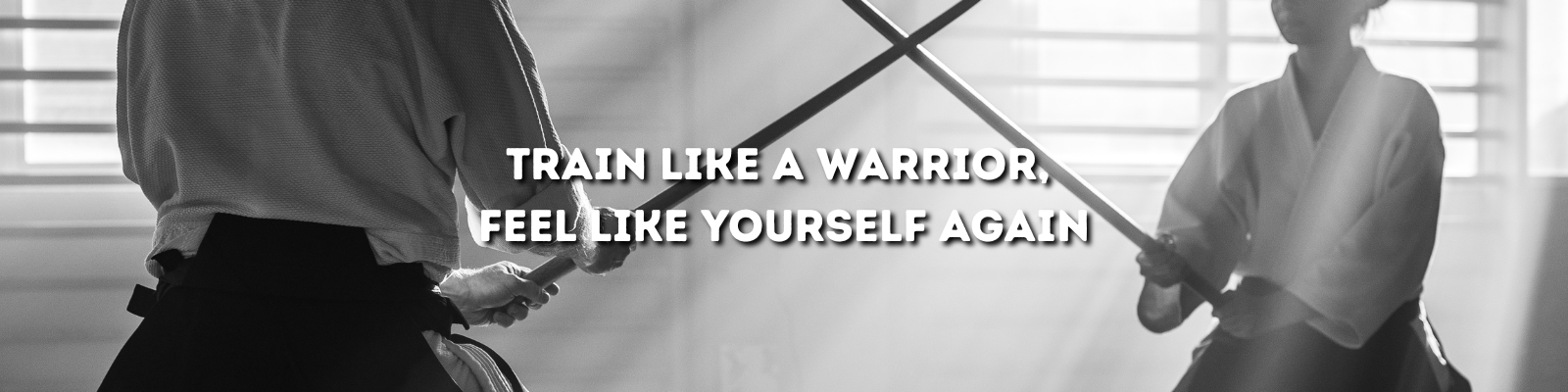
Train Like a Warrior, Feel Like Yourself Again
May is Mental Health Awareness Month. So, let’s talk about stress.
Stress shows up in your body first. Tight shoulders. Shallow breathing. Clenched jaw. Scattered focus. Low patience. Low energy.
Most people look for a mental or emotional fix for that. But the entry point is physical. And that is where sword training comes in — not as a cure, not as therapy, but as a practice that gives you a concrete way to train control when life feels loud.
That is what this month of May is about. Focus, breath, and what happens when you put them together consistently.
Why Your Mind Goes Quiet When You Pick Up a Blade
Stress pulls your mind into the future.
“What if this goes wrong?” “What am I forgetting?” “What’s next?”
Sword training pulls you back into now. Not because it is relaxing but because it demands something from you. When you step into a stance you have one job. When you move through a cutting drill there is no room for yesterday’s meeting or tomorrow’s deadline. Your body tells the truth fast.
You cannot fake presence with a blade in your hand.
That is one-point focus. One stance. One line. One rep. One breath. That is not small. That is a reset.
The Breath Is the Control Switch
When stress spikes, breathing gets shallow. That tells your nervous system the threat is still active, even when you are sitting in traffic or staring at a screen.
Training your breath changes that signal.
Every SXP event starts with breath work in the warm-up. That is intentional. When you breathe with control you lower tension in the shoulders and jaw, your movement smooths out, you recover faster between reps, and you can actually think.
This is also one of the most practical things we teach because you do not need a sword to use it. You have it with you all the time.
Move Like a Warrior: What Decades of Training Actually Teaches You
“I have spent a long time performing, teaching, and training movement at different levels. And one thing I have watched consistently is this: aging is not the enemy. Loss of signal quality is.”
Here is what that means. After age 30 things begin to shift. By the time most people reach their 60s and 70s, everyday movement feels harder not necessarily because the muscles are gone, but because the nervous system has grown cautious.
“You don’t lose ability first, you lose neural confidence.”
Neural confidence is the brain’s ongoing assessment of whether a movement is safe. When that erodes, the shoulders guard, the neck stiffens, reaction speed drops and the body starts protecting itself from damage it has not even experienced yet. This is why people feel older than they actually are.
The answer is not harder training. It is smarter training. And slow, precise, deliberate sword work is one of the best tools for rebuilding that signal. Be precise, Watch your movements. Anyone can swing a sword, but it takes time to swing one correctly.
What Flow Actually Feels Like
When the movement is clear, the speed is controlled, the breathing stays steady, and the reps feel clean that is flow.
It is not magic. It is what happens when your nervous system stops bracing. It is why people leave a session feeling better than when they walked in. Not just tired. Actually lighter. That is effort with regulation, and it is something you can train.
Our 2026 standard is A Cut Above the Rest. The skill we are building all year is Control the Moment. This month that means focus, breath, and flow.
New to SXP? Here’s How to Start Right Now
You don’t need any experience. You don’t need a sword. You don’t need to be in peak shape. All you need is 10 minutes, a willingness to try something different and patience. It may feel boring at first but as you continue to train you will find different things happening to your body. You may feel your feet connected to the ground, or not. Change it. You may feel your shoulders aching, which will tell you to relax them. Small things like this will stop you from getting into bad habits. Ones that later will be harder to fix.
Try This 10-Minute Stress-to-Control Session
Use this when you feel overwhelmed, distracted, or tense. No equipment needed.
Step 1: Downshift Breath — 2 Minutes
Stand tall. Soften your shoulders. Unclench your jaw. Inhale through your nose for a count of 4. Exhale slowly for a count of 6. Repeat 8–10 times. This alone tells your nervous system the threat is over.
Step 2: Stance & Posture — 2 Minutes
Step your feet shoulder-width apart, one foot slightly forward. Feel the ground under you. Stack your ribs over your hips. Breathe slowly and steadily. This is your foundation — in sword work and in life.
Step 3: Slow Line Reps — 4 Minutes
With empty hands, trace a simple diagonal cut line — from high right to low left. Move slow enough that you could stop at any point mid-motion. Reset fully between each rep. Do 10 reps. Rule: if you start speeding up, go slower.
Step 4: Quiet Footwork — 2 Minutes
Take small, quiet steps forward and back. Land softly. Keep your posture stable and your breath steady. This is how you train “Control the Moment” when your nervous system wants to sprint.
That’s it. Ten minutes. And it compounds so the more consistently you practice this, the faster your nervous system learns to return to calm.
Training for the Long Game: Staying Sharp at Every Age
This is not just for young athletes or action fans. I have seen people in their 50s, 60s, and 70s transform how they move and how they feel through consistent sword practice. Age is not the barrier. Stopping movement is.
The people I have watched stay fast, smooth, and pain-managed well into older age all tend to do the same three things:
1. They Keep the Spine Talking
The spine needs frequent, gentle movement — not occasional aggressive stretching. If you have stiffness in your shoulders, back, or neck, the answer isn’t to rest it into silence. The answer is daily micro-movement that tells the nervous system: “I still move here.”
Try these daily:
- Gentle neck rotations (pain-free range only)
- Thoracic rotation (turning side to side from your mid-back)
- Shoulder blade movement — circles, squeezes, releases
2. They Train Power, Not Fatigue
This is the biggest mindset shift for aging athletes. You don’t need long grinding sessions or to chase soreness. You need short bursts, clean mechanics, and to stop before exhaustion.
Instead of 40 minutes of hard training, try 10–20 seconds of focused explosive movement, then full recovery, then repeat two or three times. The nervous system stays sharp instead of going into protective mode. Fatigue leads to compensation — and compensation leads to injury.
3. They Protect the Signal
Low-intensity precision movements — slow sword flow, a controlled kata, deliberate footwork with smooth transitions — do something remarkable: they tell the brain this range of motion is safe. Pain and tension gradually reduce. Five to ten minutes of this daily, beats one or two hard sessions a week, every time.
A quick note on supplements: While no supplement replaces movement, some support the work from the inside. Adrian recommends researching Omega-3s for joint recovery and brain speed, Collagen Peptides for connective tissue, Creatine Monohydrate for muscle and cognitive function, and Vitamin D3+K2 for bone health and strength — especially if you spend time indoors. Always research the best brands for your individual needs.
The Takeaway
You do not need to be calm all the time. You need a way to return to calm when it matters.
That is what we train.
Focus pulls you into the present. Breath gives you a control switch. Consistent deliberate movement keeps your signal quality sharp — not just this month, but for years.
Stress is real. Aging is real. But so is the ability to Control the Moment. That is a skill. And skills can be built.
“Aging isn’t loss of strength — it’s loss of signal quality. Regular movement protects that signal, so you can train like a warrior well into your 70s and beyond.”
Come Train With Us
Reading about this is a start. Doing it in a room with other people, with instruction and feedback, is something different. That is where the reset sticks.
If you have never picked up a sword before, good. We start everyone from the beginning.
If you have been training for years, there is always more to sharpen. Either way, there is a place for you at an SXP event.
Upcoming Spring Events — 2026
🗡 Elite Event | Long Island, NY
Start Date: May 9, 2026 (SOLD OUT)
Start Date: May 23, 2026
Start Date: June 7, 2026
New to SXP? Every event starts with the fundamentals. All levels are welcome. Find your event and register at swordxp.com/tour-dates
Follow us on social media and join the conversation. Share your training, your progress, or just let us know you showed up and use these hashtags so we can find you:
#ControlTheMoment | #SwordExperience | #ACutAboveTheRest | #MovelikeaWarrior | #MentalHealthAwarenessMonth
No approved comments yet.

Leave a Reply